Sunday, April 6, 2008

Arthur C. Clarke


Sadly, the few days before we all went off to spring break, a time that seems so long ago, no one mentioned a word about Arthur C. Clarke. The visionary writer died on March 19 at the age of 90.

I'm sure that many of us saw the epic Stanley Kubrick film 2001 based on Clarke's short story the sentinel, but in addition, Clarke also drew up the first plans for artificial satellites in 1945, at a time when space and communications seemed to be wholly unrelated. I indeed watched 2001: a space odyssey and the sequel, then read the following two books, all of which I really enjoyed. I've read a bunch of his other stories including Childhood's End.

But aside from being an amazing writer, Clarke was a scientist. Through his books so many people's minds have been opened to science but better yet, they have been exposed to doing the impossible.
Here are Clarke’s Three Laws: published in his Profiles of the Future

1. “When a distinguished but elderly scientist states that something is possible, he is almost certainly right. When he states that something is impossible, he is very probably wrong.”

2. “The only way of discovering the limits of the possible is to venture a little way past them into the impossible.”

3. “Any sufficiently advanced technology is indistinguishable from magic.”

His visions and optimism certainly have inspired many including myself. These visions have in turn helped bring about his predictions into reality. From a wholly unrelated play, South Pacific, comes an entirely appropriate quote, "How you gonna have a dream come true, if you don't have a dream".

Far from being my favourite science-fiction author he still grabbed my attention with his sweeping overviews of what the future holds. He made the impossible look so feasible, and its more of this attitude that is needed to give dreamers hope of making dreams into reality.

And so ends my pitifully unworthy tribute to a great man, Arthur C. Clarke. A man who helped to inspire exploration in us all of the world around us and of the world inside ourselves. I hope his visionary optimism of the future lives on in scientists and others around the world. Have a nice weekend everyone.

Sunday, March 16, 2008

The End of Cosmology


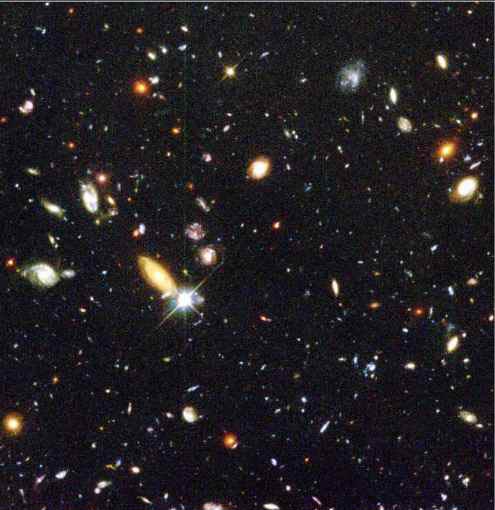
A 100 trillion years from now the last stars will fade out and the only lights will be a few dim black holes and the artificial lights of civilization, at least according to the latest issue of scientific american.

There are 400 billion galaxies in our universe. And one decade ago cosmologists made the discovery that the universe's expansion is accelerating. One day the skies will be empty (if earth gets through the next 100 trillion years..). In the future the universe will look like a puddle of stars and then drop completely out of view. The article also brings up the issue of what evidence from the past we could have already lost.

This obviously relates to physics because of things that we study like light and optics. Light is fast (ha) but the distances in the universe are unimaginably immense. In addition one must wonder how to deal with a vast universe in terms of Newton's theory of universal gravitation because theres just so much matter.

But in relevance to human society it still has implications. No human will be around 100 trillion realistically speaking. But like Copernicus 500 years ago, these discovery change our attitude towards the earth and the universe. We are incredibly small to put it bluntly. And the universe itself is neither constant nor eternal.

Grand implications indeed to think about. Have a nice weekend everyone.

Sunday, March 9, 2008

The Opti-Gone Mirage


What a fantastic trademarked name.. ha. and what an awesome photo!..

thank goodness we had a day to think about this. But i think i now have the general idea. The insides of the mirage generator is lined with a reflective surface. The top and bottom act as two concave mirrors. Thus, the object at the bottom is at the focus point of the top mirror. Light rays go through the top mirror focus from the object, and reflect parallel down to the bottom mirror. These light rays reflect towards the focus of the bottom mirror, which is opposite the one at the bottom, therefore producing the illusion that there is an object where it is not.

have a nice rest of the weekend everyone!

Monday, March 3, 2008

Galerie des Glaces


The hall of mirrors is immediately what came to mind. It is a hallway full of mirrors in the Palace of Versailles just outside of Paris. Sadly when i was there it was being partially renovated. But at least i got to see some of it!
When two mirrors are placed parallel to each other the images made by each mirrors gets seen by the parallel and so on. This means an infinite number of images in the mirrors.
One can almost imagine Wilhelm I being proclaimed Kaiser..
The hall is quite elegant and so many mirrors increases the ambient light as well.
Anyways, can't write much more, have a nice remaining weekend everyone! Something like an hour and half of it.

Sunday, February 24, 2008

Transformers:More than Meets the Eye


Sadly, my valley loses power more than any place i've ever been. Even where my grandparents live in Southern Taiwan, during a freaking hurricane for god sakes, keeps its power more regularly. Yes, I can say with near certainty that I lose power roughly one every 1-2 months.
But why? To my chagrin i really don't know. But i have my hunches. It's probably some transformer at the base of my valley or some place in the electrical substation that blows out.
So transformers... (insert robot joke here) they transfer the low current high voltage to be stepped down into more manageable electricity for homes and/or different areas. They have coils of different number of turns to allow alternating current (because it produces a magnetic flux) to either be stepped down or up.
The number of turns multiplied by the change in magnetic flux over the time it takes will give the voltage.
So why do they fail so often in my valley (assuming that they are even the problem)? Maybe overload, faulty parts, or maybe its the weather that can get to them, i have no clue.
Anyways, have a nice weekend everyone, and yes so far i've had power this whole weekend, nice!

Sunday, February 10, 2008

Dr. Hayashi's Talk


I was duly impressed with Dr. Hayashi’s ebullient and contagious optimism. Not only did she clearly liked talking to her audience, but immensely liked her work as well. But what truly struck me was her remark on education. I agree that what this country needs are more thinkers. Maybe not just scientists, but people that have the minds of scientists: clear and open minds. As I have probably mentioned before, China’s politburo is composed almost entirely of scientists; China is a technocracy. Concerned less with power they send the country in a forward and future looking path.
On the other and more ominous hand Muslim countries hardly make any impact on the world’s affairs. Although there are over a billion Muslims only two have ever won a Nobel Prize, in addition, one of these winners, a Pakistani, was barred from speaking in his native land. Today’s situation is a far cry from the golden times of early Arab rule during which Muslim Arabs led the world in scientific progress, a time when the rest of Europe was in the Dark Ages.
What went wrong? Invasions and Turkic peoples certainly destroyed the progress Arabs had made but there were also fewer people like Dr. Hayashi. When thinking becomes conservative and closed people will and can suffer terrible conditions.
This is why it was very encouraging to hear Dr. Hayashi speak so eloquently and passionately about spider silk. I know that people must question the reasons why scientists pursue these stretches of science when there is no apparent impact on people (for instance creatures on the ocean floor or in the far reaches of space). Nevertheless, there are indeed some very potentially profound and interesting applications for spider silk. One day there might be spider silk factories churning out either biological or synthetic silk to make incredibly strong materials. Her work compares to the fantastic qualities of the Spiderman comic. Like Spiderman, Dr. Hayashi’s work has the quality to be significant in people’s lives.
When scientists, like Dr. Hayashi, look for answers they open minds. All of a sudden there are many more paths to take. If only our politicians in the world had the training that Dr. Hayashi had. Scientists gather to figure out more about the genome, build the ISS, and test out CERN when the world’s politicians can’t come to terms with anything. Science is optimism; it is the general mood that things can be changed for the better. And optimism is something sorely needed in today’s world of gloom and doom.
Personally I feel that it made me realize that being open-minded is a golden quality. She had no idea what she wanted to do and it was by chance she had the opportunity to get into spiders. I just hope I have the same luck in finding equally golden opportunities.

Sunday, February 3, 2008

Aqua Script


I just saw this system of displaying moving text and images using falling drops of water. Its called "Aqua Script" and reminded me of the physics that we have already done and will soon do. It is 2 meters long with a number of magnet-valves that can expel single water-drops on demand. It creates a virtual floating billboard effect and requires a computer to coordinate the timing and speeds of each water droplet to simulate the text made the water drops. So kinematics are definitely required to make this project a reality.

But furthermore this is an example of something interdisciplinary, or at least something in between art and science. So now I'm going to find some super bowl commercials to watch since I missed the game. Enjoy the weekend everyone!