Sunday, December 9, 2007
Sound
Guitars may be played acoustically, where the tone is produced by vibration of the strings and modulated by the hollow body, or they may rely on an amplifier that can electronically manipulate tone. The above clip is an example of the electric guitar being played by Tom Morello who has a distinct way of playing with multiple effects. Although it must seem like he has a dozen different pedals to make all these sounds that should be coming from a synthesizer he uses only a wah, whammy, and delay. The killswitch is important too to cut off sounds. He makes the guitar sound like anything but a guitar at some times.
I learned a bunch of other things about the guitar. And about my violin as well. Such as the bridge, to me it seemed somewhat useless. But instead the main purpose of the bridge on a guitar or violin is to transfer the vibration from the strings to the soundboard, which vibrates the air inside of the instrument, thereby amplifying the sound produced by the strings. Well thats pretty important.
Oftentimes i wish i had an electric violin to play around with the various effects. If i did i would have a violin without much of a body. It would have pickups however. Pickups are attached to a guitar/violin that detect (or "pick up") string vibrations and convert the mechanical energy of the string into electrical energy. The resultant electrical signal can then be electronically amplified. And in regards to the whammy bar, it allows me to modulate the pitch moving the bridge up and down.
Very interesting chapter on sound. Especially since its such an inescapable part of our lives. Yet, such an enjoyable part.

Sunday, December 2, 2007
Excuse me while I kiss the sky!
Yes. Hey Joe! I love how Hendrix plays his strat upside down because he's a lefty. His strings even sound different too.
I can't wait for chapter 17 on sound. I couldn't bear rehash the simple harmonic motion that we just covered. I guess all i've got to remember is the usage of conservation of E total. Actually, we've to rememeber everything we've covered right?
Next week ill try to attempt explain different techniques and stuff using physics. Fun fun :) In the meantime however, im sick.
Sunday, November 25, 2007
Bungee Jumping!
So that's a short on bungee jumping at the original bungee jumping site in Queenstown, New Zealand with an introduction by a bungee company.
If the spring action on the bungee cord wasn't dampened then this would be an example of simple harmonic motion. However, no one would be able to stop, so that wouldn't be good for advertising. The motion is periodic, as it repeats itself with intervals in a specific manner; it is described as being sinusoidal, with constant amplitude. A motion with frequency f has period = 1/f. Thus if there was a period of 4 seconds the frequency would be 0.25 hertz.
Okay well that's it from me. I'm going to enjoy the rest of my thanksgiving break. There really is so much I have to be thankful for and I should be thankful year round.
Monday, November 19, 2007
The Challenger Deep

My homepage for Safari is a random page on wikipedia. I'll say that 40% I find a useless irrelevant page like one on some unknown district in India or in Minnesota. However, the other times I can find true gems and oddities (Vang Stone or Australian Senate election of 1967). This time though I found something that correlates with my work in physics and fluid motion.
The Mariana Trench is the worlds deepest oceanic trench. It goes down to a maximum 11 km down. This makes it the deepest location on the surface of the earth's crust. It is located where the Pacific plate is subducted beneath the Philippine plate. In 1960 the bathyscape(similar to a spherical shape so as not to be crushed by the intense pressure) "Trieste" reached the bottom with two men. The gauge presure of the seawater at the bottom is 1030kg/mcubed times 9.8m/s squared times 11000m. This is equal to 111034000 Pascals. This is over a thousand times greater than the atmospheric pressure we experience at sea level! It is almost scary to imagine the sheer darkness and fear one would experince being at that depth, although life persists even at that depth (foot long flounders and shrimp).
So now I've gone from space to the depths of the ocean. Hauntingly but beautifully, physics is omnipresent.
Saturday, November 10, 2007
Eleven Flights More :(
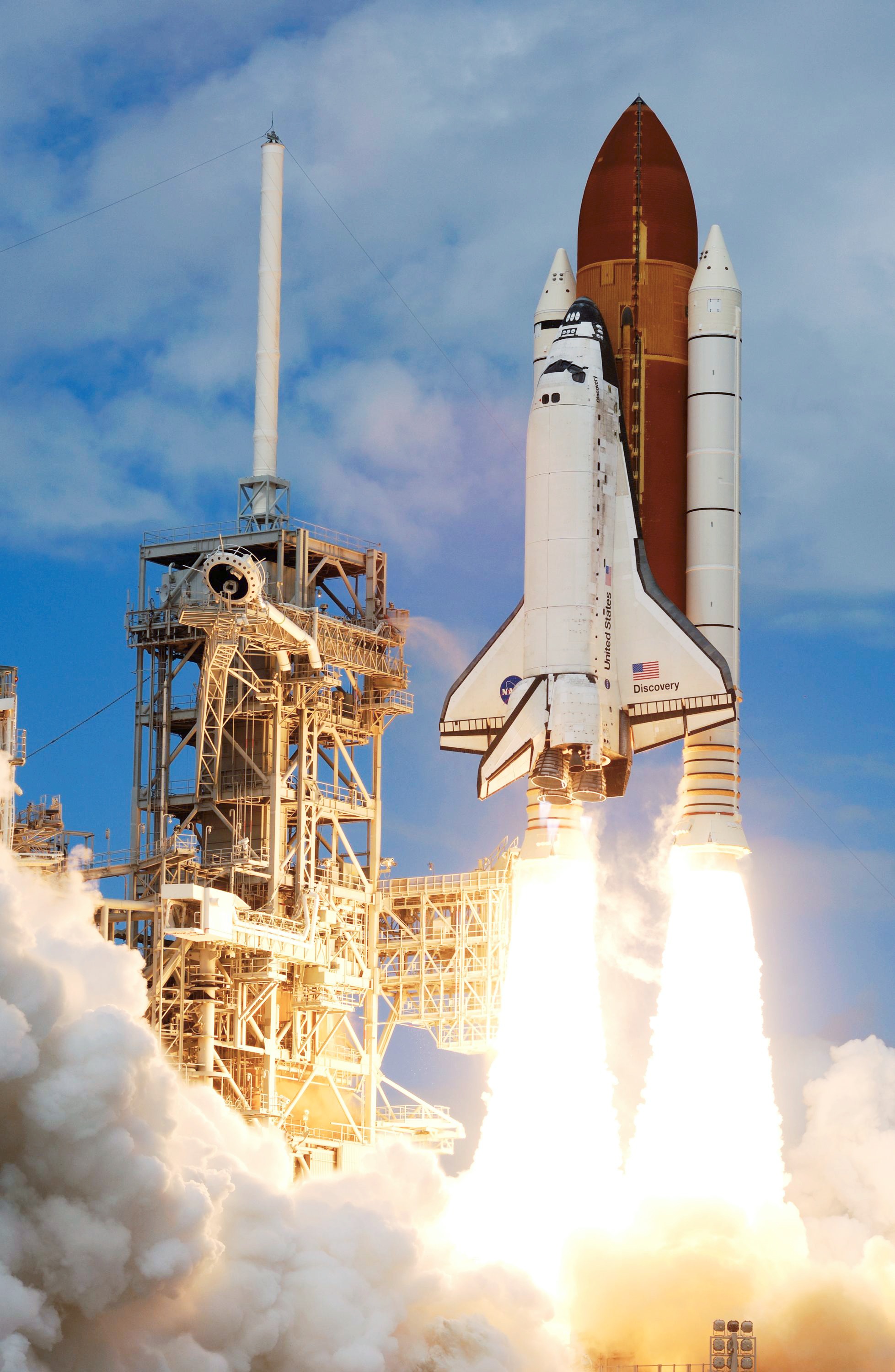
Mission STS-120 was a space shuttle mission (Discovery) to the ISS that was launched on October 23 and landed this Wednesday the 7th. Sadly however, I was reminded that only eleven more missions will be flown by the space shuttle program until its decommissioning in 2010. On a better note the ISS is one more module closer to completion as the Harmony module (a US module built in Italy as part of a joint ESA-NASA deal) was attached; it is a habitat module, and repairs were also performed.
The ecape velocity needed was 11200 m/s this escape velocity does not depend on the mass of the space shuttle although it may require more or less energy depending on the payload of the space shuttle. The space shuttle escaped earth gravity to enter into a LEO or low earth orbit to meet with the ISS at about 320 km above the earths surface. The value of g at this height is GM over (r + 320km)squared. However, since this is at such a low (comparatively) orbit the value of g here is nearly the same as on the surface. The weightlessness is caused by the effects of freefall.
Sunday, November 4, 2007
Heres a video that made me wonder what the initial angular acceleration of the system with the Tundra truck would be if my family's four door sedan was placed on the other side of the seesaw. Assuming the whole seesaw is 70m long then the Tundra truck would be at 25m from the fulcrum while on the otherside my family car would be 35m away from the fulcrum on the right side of the seesaw. The video states the truck is 10000 pounds (4535.9 kg) while my car is probably around 4000 pounds (1814.3 kg) and the mass of the seesaw is probably 10000 pounds (4535.9 kg).
First, inertia of the system would be needed. I = (truck)mr^2 + (car)mr^2 + IS
By substituting values for the variables and I of the seesaw is 1/2ML^2 one finds that the system's moment of inertia is equal to 6909614.2 kg*m^2.
Now net torque is found by adding the torques of the car and the truck. Which is 488990 N*m.
Σt = iα and so angular acceleration is 0.0708 rad/s^squared. Its kinda slow but it makes sense when dealing with large masses that are nearly equidistance from the fulcrum.
In the video it is clear the initial angular acceleration is much larger when only the truck is on the seesaw at a great distance from the fulcrum.
Saturday, October 27, 2007
Fly Gundam!
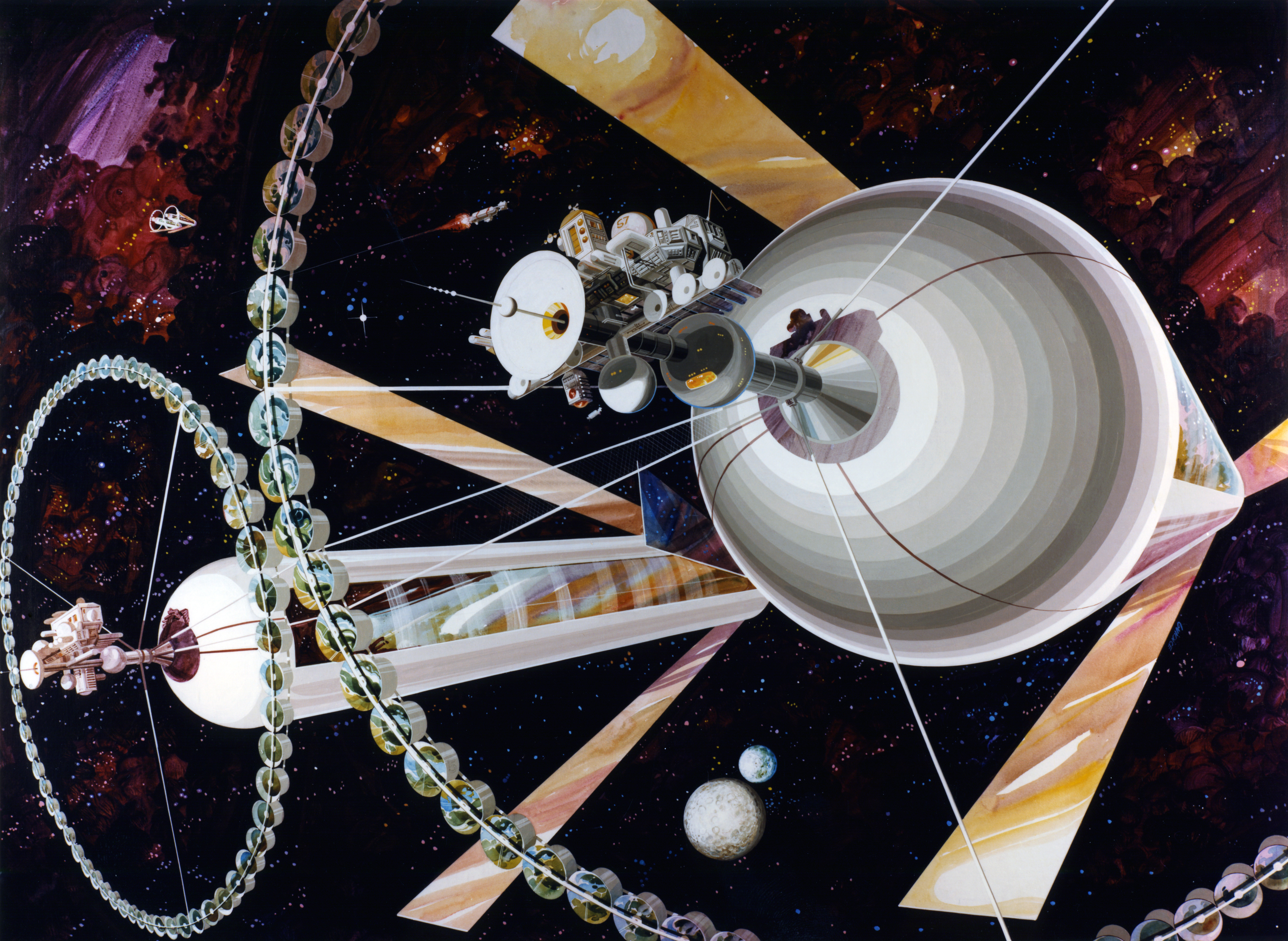
I was watching an episode of 0080: war in the pocket. I noticed the space colonies were rotating. The different sections had different rotational speeds.
With further research I found out that many of these colonies are called O'Neill cylinders. One the first designs was "island one" a sphere with a diameter of 1.609km (804.5m). So to find the velocity at which the colony would have to rotate is using F= m(vsquared/r) to get 88.8 m/s. Another design calls for a cylinder rotating in different sections at different speeds. There is even an outer ring that rotates at various speeds for farming. In Gundam, the cylinders probably rotate way faster than 88.8 m/s since the rotation is too fast (for visual effect). Interestingly, in Rendezvous with Rama the object being explored also seems to be an O'Neill cylinder except without the mirrors and windows (needed for light).
These cylinders would need to be placed at Lagrange points. These points would allow a colony (only affected by gravity) to remain stationary between two objects, say the moon and earth. <
A large problem that confronts space exploration is the effect that radiation in space will have on colonists/explorers. At the scale of the O'Neill cylinder however, the air and the steel (perhaps another metal) hull will be sufficient protection.
Personally I can't wait for space colonies.. there's just something so enticing about space.
Subscribe to:
Posts (Atom)